

 Image 1 of 1
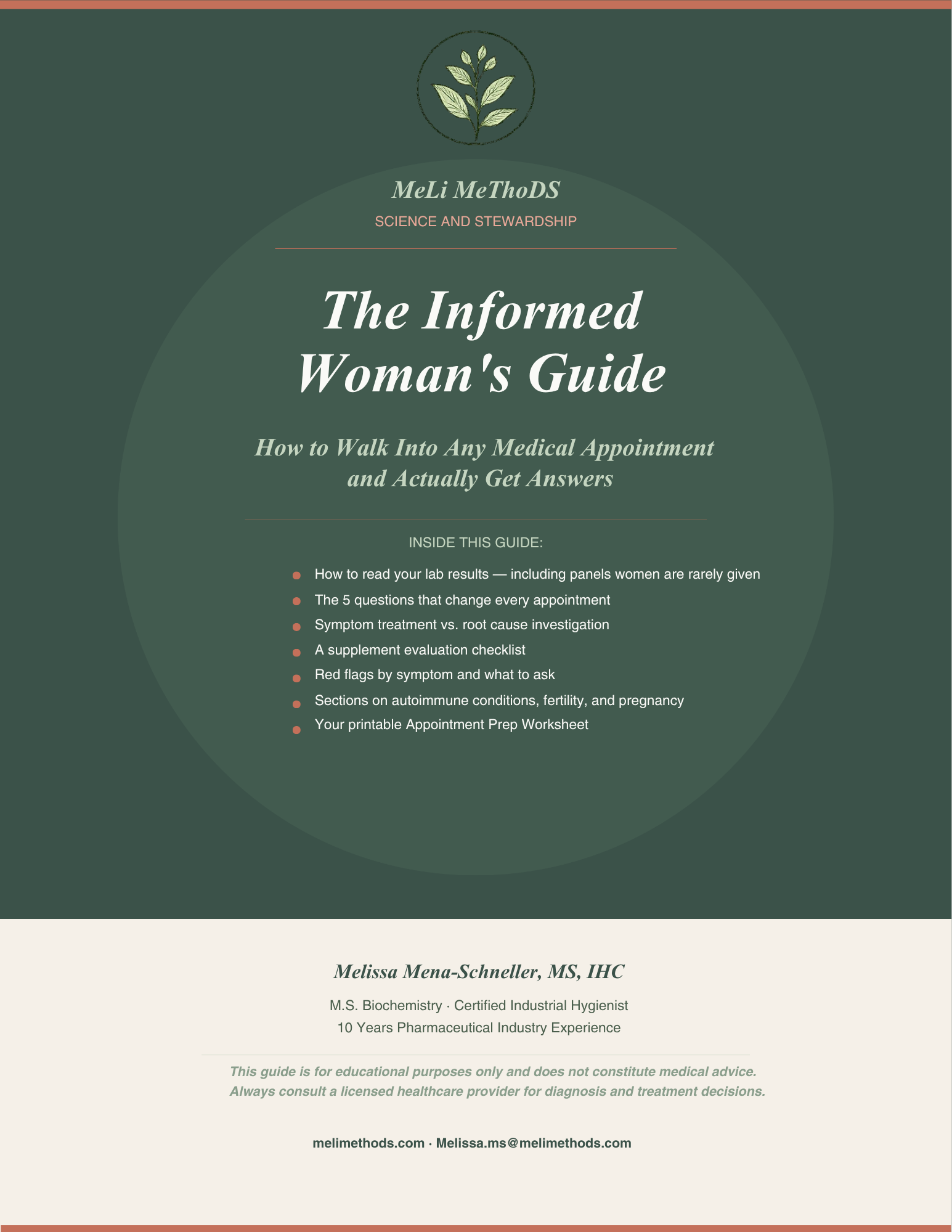
The Informed Woman's Guide [Digital Download]
Most women are handed a lab result, told everything looks normal, and sent home. No explanation of what the numbers actually mean. No conversation about what optimal looks like for their age or hormonal stage. No mention of the panels that were never ordered, the cycle day that was never recorded, or the autoimmune markers that were never screened. And no acknowledgment that many of the symptoms sitting in that exam room have been studied, published, and biochemically explained for years.
The Informed Woman's Guide was written for that experience.
This is not a wellness journal. It is not a hormone balancing protocol. It is a science backed reference written by a biochemist with 10 years of pharmaceutical experience who looks at the human body the way a medicinal researcher looks at a potential medicine: down to the molecule, following every clue upstream until it reaches a source.
Women's health is one of the most under-researched and over-simplified areas in medicine. Clinical trials excluded women entirely for decades. Symptoms that are common in women have been dismissed as anxiety, stress, or simply the cost of being a woman. Autoimmune diseases, which affect women at nearly four times the rate of men, are among the most frequently delayed diagnoses in medicine. That is not a personal failing. It is a systemic one. This guide helps you start correcting it.
What is inside:
Seven Lab Panels Worth Understanding covers the CBC with ferritin tested separately from hemoglobin because ferritin can be depleted long before anemia appears on paper, the full hormonal panel including estradiol, progesterone timed to the correct cycle day, LH, FSH, DHEA-S, free and total testosterone, and SHBG because a hormonal picture without cycle day context is often uninterpretable. It covers the full thyroid panel beyond TSH alone, including Free T3, Free T4, Reverse T3, and thyroid antibodies to screen for Hashimoto's, which is the most common autoimmune condition in women and the most commonly missed cause of hypothyroid symptoms. It covers the full B vitamin family by every name, including why women on oral contraceptives are rarely told that their prescription depletes magnesium, B6, B12, folate, and zinc. It covers lipid panels with hormonal context because estrogen raises HDL and lowers LDL, meaning cardiovascular risk shifts significantly during perimenopause. And it covers fasting insulin alongside fasting glucose because insulin resistance develops years before glucose becomes abnormal and drives androgen excess in PCOS, disrupts progesterone production, accelerates perimenopause symptoms, and impairs thyroid hormone conversion.
The Five Questions That Change Every Appointment are written specifically for the women's health context, where symptoms have been historically dismissed and where treatment is frequently offered before the mechanism is understood. They cover the difference between managing a symptom and investigating a cause, what optimal looks like for your specific age and hormonal stage versus what is simply not flagged, how to ask for the pattern across the full panel because hormonal imbalance in women is almost never isolated, and one of the most important and overlooked questions: what nutrients a treatment is known to deplete. Oral contraceptives deplete magnesium, B6, B12, folate, and zinc. SSRIs can affect B12, folate, and CoQ10. Metformin depletes B12. Most women are never told.
Symptom Treatment vs. Root Cause Investigation explains the difference with examples drawn directly from women's health. Hormonal birth control prescribed for painful periods without investigating prostaglandin imbalance, endometriosis, or low progesterone. Antidepressants initiated before cortisol rhythm, Free T3, progesterone, and B6 have been ruled out as contributors. Iron supplements given without asking why iron is low, whether it is dietary, absorption, heavy bleeding, gut inflammation, or SIBO, because each one requires a different intervention.
The Supplement Evaluation Checklist applies pharmaceutical evaluation standards to what women are most commonly sold: magnesium glycinate versus oxide, methylfolate versus folic acid and why the difference matters especially with MTHFR variants, iron bisglycinate versus ferrous sulfate, ubiquinol versus ubiquinone, third party testing, absorption cofactors that are frequently missing, and whether a supplement is solving the root issue or adding a layer on top.
Red Flags by Symptom maps eight of the most common presentations in women: persistent fatigue and brain fog, irregular cycles and heavy bleeding, mood changes and anxiety, hair loss, gut health and the estrobolome connection, skin conditions, bone density, and sleep disruption, to the specific labs worth requesting and the specific questions worth asking for each one. Not to diagnose. To investigate upstream before accepting a downstream explanation.
The guide includes a dedicated section on Autoimmune Conditions in Women, covering why women are disproportionately affected, the most common conditions and their lab markers including Hashimoto's, rheumatoid arthritis, lupus, celiac, and Sjogren's, the bidirectional relationship between gut health and autoimmune activity, and the nutritional supports with documented roles in immune regulation.
It includes a section on Fertility, Pregnancy, and Postpartum Health covering what to test three to six months before conception, what to monitor beyond standard prenatal labs, why the postpartum period is one of the most medically neglected phases in a woman's life, and a reframing of PCOS as a metabolic and hormonal signaling disorder with distinct subtypes that each require different interventions.
The guide closes with printable Appointment Prep Worksheets designed to be brought to every visit.
Your biology is specific. Your hormonal stage is specific. The molecular picture driving your symptoms is specific to you.
This guide gives you the language to find out what it is.
You have been patient long enough. Now you have the questions.
Science and Stewardship. MeLi MeThoDS.
Most women are handed a lab result, told everything looks normal, and sent home. No explanation of what the numbers actually mean. No conversation about what optimal looks like for their age or hormonal stage. No mention of the panels that were never ordered, the cycle day that was never recorded, or the autoimmune markers that were never screened. And no acknowledgment that many of the symptoms sitting in that exam room have been studied, published, and biochemically explained for years.
The Informed Woman's Guide was written for that experience.
This is not a wellness journal. It is not a hormone balancing protocol. It is a science backed reference written by a biochemist with 10 years of pharmaceutical experience who looks at the human body the way a medicinal researcher looks at a potential medicine: down to the molecule, following every clue upstream until it reaches a source.
Women's health is one of the most under-researched and over-simplified areas in medicine. Clinical trials excluded women entirely for decades. Symptoms that are common in women have been dismissed as anxiety, stress, or simply the cost of being a woman. Autoimmune diseases, which affect women at nearly four times the rate of men, are among the most frequently delayed diagnoses in medicine. That is not a personal failing. It is a systemic one. This guide helps you start correcting it.
What is inside:
Seven Lab Panels Worth Understanding covers the CBC with ferritin tested separately from hemoglobin because ferritin can be depleted long before anemia appears on paper, the full hormonal panel including estradiol, progesterone timed to the correct cycle day, LH, FSH, DHEA-S, free and total testosterone, and SHBG because a hormonal picture without cycle day context is often uninterpretable. It covers the full thyroid panel beyond TSH alone, including Free T3, Free T4, Reverse T3, and thyroid antibodies to screen for Hashimoto's, which is the most common autoimmune condition in women and the most commonly missed cause of hypothyroid symptoms. It covers the full B vitamin family by every name, including why women on oral contraceptives are rarely told that their prescription depletes magnesium, B6, B12, folate, and zinc. It covers lipid panels with hormonal context because estrogen raises HDL and lowers LDL, meaning cardiovascular risk shifts significantly during perimenopause. And it covers fasting insulin alongside fasting glucose because insulin resistance develops years before glucose becomes abnormal and drives androgen excess in PCOS, disrupts progesterone production, accelerates perimenopause symptoms, and impairs thyroid hormone conversion.
The Five Questions That Change Every Appointment are written specifically for the women's health context, where symptoms have been historically dismissed and where treatment is frequently offered before the mechanism is understood. They cover the difference between managing a symptom and investigating a cause, what optimal looks like for your specific age and hormonal stage versus what is simply not flagged, how to ask for the pattern across the full panel because hormonal imbalance in women is almost never isolated, and one of the most important and overlooked questions: what nutrients a treatment is known to deplete. Oral contraceptives deplete magnesium, B6, B12, folate, and zinc. SSRIs can affect B12, folate, and CoQ10. Metformin depletes B12. Most women are never told.
Symptom Treatment vs. Root Cause Investigation explains the difference with examples drawn directly from women's health. Hormonal birth control prescribed for painful periods without investigating prostaglandin imbalance, endometriosis, or low progesterone. Antidepressants initiated before cortisol rhythm, Free T3, progesterone, and B6 have been ruled out as contributors. Iron supplements given without asking why iron is low, whether it is dietary, absorption, heavy bleeding, gut inflammation, or SIBO, because each one requires a different intervention.
The Supplement Evaluation Checklist applies pharmaceutical evaluation standards to what women are most commonly sold: magnesium glycinate versus oxide, methylfolate versus folic acid and why the difference matters especially with MTHFR variants, iron bisglycinate versus ferrous sulfate, ubiquinol versus ubiquinone, third party testing, absorption cofactors that are frequently missing, and whether a supplement is solving the root issue or adding a layer on top.
Red Flags by Symptom maps eight of the most common presentations in women: persistent fatigue and brain fog, irregular cycles and heavy bleeding, mood changes and anxiety, hair loss, gut health and the estrobolome connection, skin conditions, bone density, and sleep disruption, to the specific labs worth requesting and the specific questions worth asking for each one. Not to diagnose. To investigate upstream before accepting a downstream explanation.
The guide includes a dedicated section on Autoimmune Conditions in Women, covering why women are disproportionately affected, the most common conditions and their lab markers including Hashimoto's, rheumatoid arthritis, lupus, celiac, and Sjogren's, the bidirectional relationship between gut health and autoimmune activity, and the nutritional supports with documented roles in immune regulation.
It includes a section on Fertility, Pregnancy, and Postpartum Health covering what to test three to six months before conception, what to monitor beyond standard prenatal labs, why the postpartum period is one of the most medically neglected phases in a woman's life, and a reframing of PCOS as a metabolic and hormonal signaling disorder with distinct subtypes that each require different interventions.
The guide closes with printable Appointment Prep Worksheets designed to be brought to every visit.
Your biology is specific. Your hormonal stage is specific. The molecular picture driving your symptoms is specific to you.
This guide gives you the language to find out what it is.
You have been patient long enough. Now you have the questions.
Science and Stewardship. MeLi MeThoDS.