

 Image 1 of 1
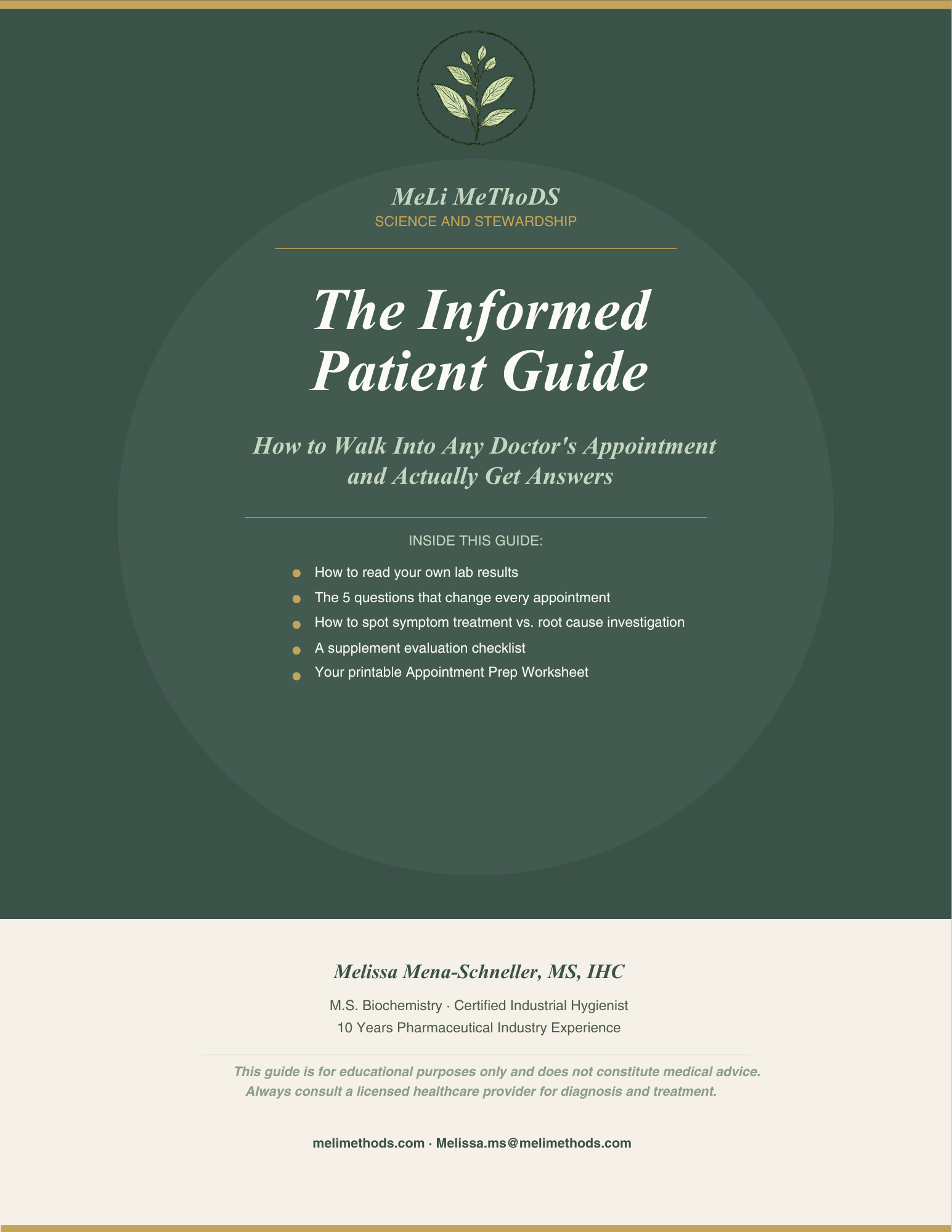
The Informed Patient's Guide [Digital Download]
You have spent time in a doctor's appointment nodding along to words you did not fully understand, leaving with a prescription and no explanation, or being told your labs are "normal" while still feeling like something is wrong. You have Googled your results and come out more confused than when you started. You have bought supplements because someone said they were good for you, without knowing whether your body actually needs them, whether the form you bought absorbs properly, or whether they interact with anything else you are taking.
The Informed Patient Guide was written for exactly that experience.
This is not a wellness book. It is not a symptom checker. It is a science-backed reference written by a biochemist with 10 years of pharmaceutical research, quality assurance, and industrial hygiene experience — someone who looks at the human body the way a medicinal researcher looks at a potential medicine: down to the molecule, following every clue upstream until it reaches a source.
What is inside:
Seven Lab Panels Worth Understanding walks you through the most important panels you are likely to encounter — the CBC, the CMP, your thyroid panel, vitamin D, B vitamins (explained by every name they go by, because riboflavin, pyridoxine, methylcobalamin, and methylfolate are not the same as the generic terms on most labels), the lipid panel, and fasting insulin. For each one, you will learn what the panel actually measures, what the difference is between a normal range and an optimal one, and what trends across visits tell you that a single snapshot never can.
The Five Questions That Change Every Appointment are the questions most patients never ask — and the ones that signal to any provider that you are an engaged, informed partner in your own care. They work for any specialist, any diagnosis, and any test result. They cover the difference between treating a symptom and investigating a cause, what optimal looks like versus what is simply not flagged, when waiting and retesting is a legitimate option, how to ask for the pattern across your labs rather than a single isolated number, and — one of the most overlooked questions in all of medicine — what nutrients a treatment is known to deplete, and whether you should be replacing them.
Symptom Treatment vs. Root Cause Investigation explains the difference between the two, shows you how to recognize which one you are receiving, and gives you the exact language to use when you want to ask for the other.
The Supplement Evaluation Checklist applies the same standards a pharmaceutical scientist uses when evaluating a compound: form, dose matched to the actual research, third-party testing, absorption cofactors, interactions, and whether the capsule technology in a specific product changes the bioavailability picture. It also covers when supplementing is adding a layer on top of an unidentified root cause — and why that matters.
Red Flags in Wellness Claims gives you the specific phrases to watch for — "clinically proven," "natural means safe," "detox support," "boosts your immune system" — and explains exactly what the science says about each one and what questions to ask instead.
The guide closes with 10 Appointment Prep Worksheets designed to be brought to every visit — with space for symptoms, a lab result tracker with a column for age-specific ranges, your five questions, and a notes section for your doctor's answers.
This guide does not tell you what is wrong with you.
What it does is give you the language to find out — and to walk into every appointment as a partner in your own health, not a passenger in it.
Your symptoms are clues. Your labs are data. Your appointments are conversations you deserve to be prepared for.
Science and Stewardship. MeLi MeThoDS.
You have spent time in a doctor's appointment nodding along to words you did not fully understand, leaving with a prescription and no explanation, or being told your labs are "normal" while still feeling like something is wrong. You have Googled your results and come out more confused than when you started. You have bought supplements because someone said they were good for you, without knowing whether your body actually needs them, whether the form you bought absorbs properly, or whether they interact with anything else you are taking.
The Informed Patient Guide was written for exactly that experience.
This is not a wellness book. It is not a symptom checker. It is a science-backed reference written by a biochemist with 10 years of pharmaceutical research, quality assurance, and industrial hygiene experience — someone who looks at the human body the way a medicinal researcher looks at a potential medicine: down to the molecule, following every clue upstream until it reaches a source.
What is inside:
Seven Lab Panels Worth Understanding walks you through the most important panels you are likely to encounter — the CBC, the CMP, your thyroid panel, vitamin D, B vitamins (explained by every name they go by, because riboflavin, pyridoxine, methylcobalamin, and methylfolate are not the same as the generic terms on most labels), the lipid panel, and fasting insulin. For each one, you will learn what the panel actually measures, what the difference is between a normal range and an optimal one, and what trends across visits tell you that a single snapshot never can.
The Five Questions That Change Every Appointment are the questions most patients never ask — and the ones that signal to any provider that you are an engaged, informed partner in your own care. They work for any specialist, any diagnosis, and any test result. They cover the difference between treating a symptom and investigating a cause, what optimal looks like versus what is simply not flagged, when waiting and retesting is a legitimate option, how to ask for the pattern across your labs rather than a single isolated number, and — one of the most overlooked questions in all of medicine — what nutrients a treatment is known to deplete, and whether you should be replacing them.
Symptom Treatment vs. Root Cause Investigation explains the difference between the two, shows you how to recognize which one you are receiving, and gives you the exact language to use when you want to ask for the other.
The Supplement Evaluation Checklist applies the same standards a pharmaceutical scientist uses when evaluating a compound: form, dose matched to the actual research, third-party testing, absorption cofactors, interactions, and whether the capsule technology in a specific product changes the bioavailability picture. It also covers when supplementing is adding a layer on top of an unidentified root cause — and why that matters.
Red Flags in Wellness Claims gives you the specific phrases to watch for — "clinically proven," "natural means safe," "detox support," "boosts your immune system" — and explains exactly what the science says about each one and what questions to ask instead.
The guide closes with 10 Appointment Prep Worksheets designed to be brought to every visit — with space for symptoms, a lab result tracker with a column for age-specific ranges, your five questions, and a notes section for your doctor's answers.
This guide does not tell you what is wrong with you.
What it does is give you the language to find out — and to walk into every appointment as a partner in your own health, not a passenger in it.
Your symptoms are clues. Your labs are data. Your appointments are conversations you deserve to be prepared for.
Science and Stewardship. MeLi MeThoDS.