

 Image 1 of 1
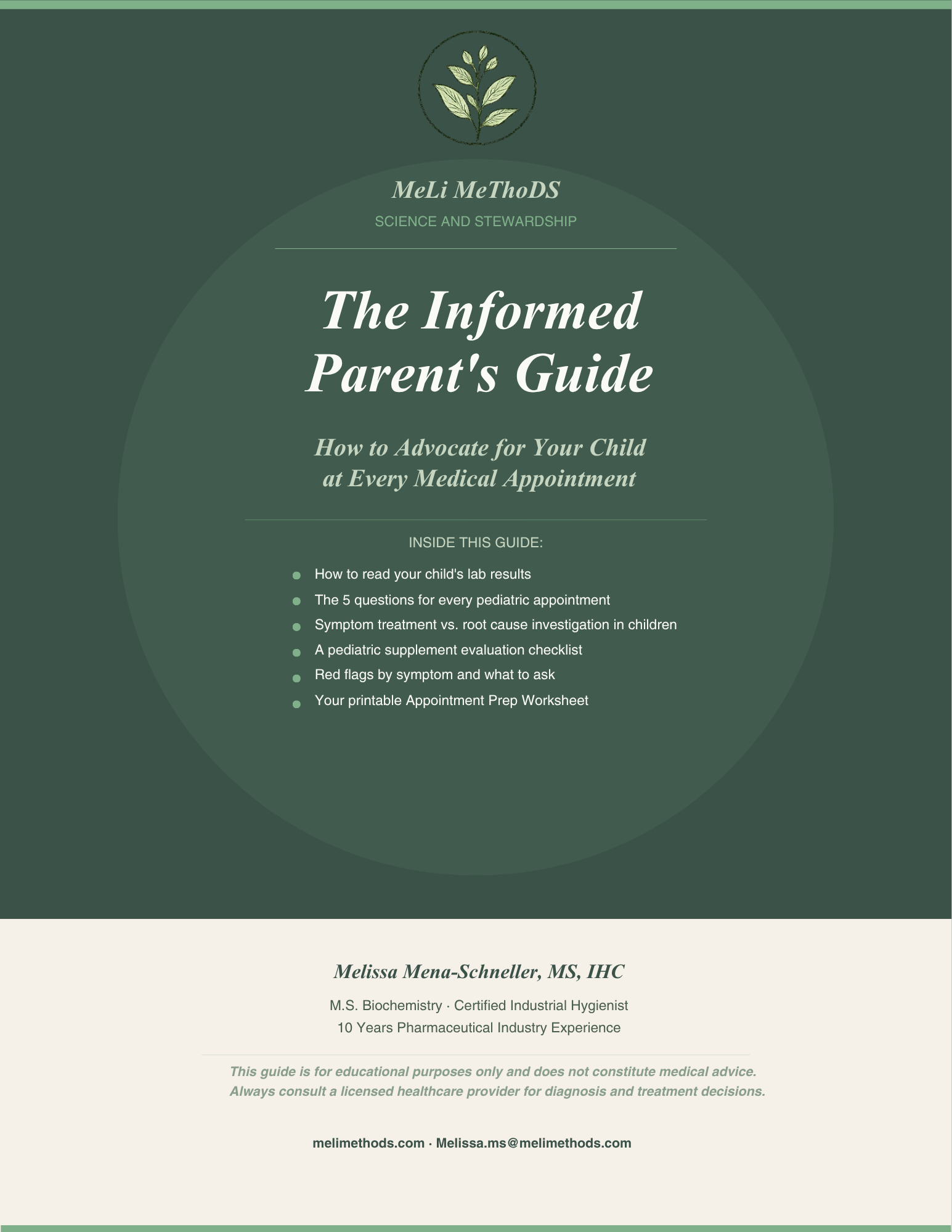
The Informed Parent's Guide [Digital Download]
You have sat in a pediatrician's office and watched your child's labs get waved through as "normal" — without anyone mentioning that those reference ranges were built from adult populations, not children. You have been handed a prescription without being told what nutrient it depletes over time. You have stood in the supplement aisle trying to figure out whether what you are buying is safe for a seven-year-old, at what dose, and in what form. You have watched a symptom get managed without anyone asking what is causing it.
The Informed Parent's Guide was written for that experience.
This is not a parenting book. It is not a list of home remedies. It is a science-backed reference written by a biochemist with 10 years of pharmaceutical experience — someone who looks at a child's health the way a researcher looks at a distinct population: with age-specific context applied to every number, every treatment, and every decision.
What is inside:
Seven Lab Panels Worth Understanding in Children covers the CBC with the ferritin and hemoglobin distinction that most pediatric reports miss, platelet count versus platelet volume, TSH and Free T3, vitamin D with the gap between "sufficient" and actually optimal for a growing child, the full B vitamin family explained by every name they go by — riboflavin, thiamine, pyridoxine, methylfolate, methylcobalamin — and why form matters as much as level, and growth markers beyond height and weight percentile, including growth velocity and IGF-1.
The Five Questions for Every Pediatric Appointment are the questions most parents never know to ask — written specifically for the pediatric context, where appointment windows are short, vocabulary gaps are significant, and the stakes of missing something early are high. They cover the difference between age-specific and adult reference ranges, what optimal looks like for a child's developmental stage, how to ask whether a symptom pattern points to something systemic showing up across multiple labs, and — one of the most overlooked conversations in pediatric care — what nutrients a medication or supplement is known to deplete.
Symptom Treatment vs. Root Cause Investigation in Children explains the difference with pediatric-specific examples, including how a focus or attention difficulty can look identical whether it is driven by low ferritin, low omega-3s, blood sugar instability, or a neurodevelopmental difference — and why knowing which one changes everything about the appropriate response.
The Pediatric Supplement Evaluation Checklist applies pharmaceutical evaluation standards to the specific context of children: age-appropriate dosing, fat-soluble vitamin toxicity risk in smaller bodies, bioavailable forms, third-party testing, cofactor interactions, and the critical question of whether a supplement is addressing a documented need or guessing at one.
Red Flags by Symptom maps seven of the most common pediatric complaints — fatigue, frequent illness, focus difficulties, slow growth, digestive issues, mood instability, and skin problems — to the specific labs worth requesting and the specific questions worth asking for each one. Not to diagnose. To investigate.
The guide closes with 10 Appointment Prep Worksheets designed for pediatric visits, with space for the child's name, age, and current medications, a lab tracker with a dedicated column for age-specific reference ranges, five question slots, and a section for recording exactly what the doctor said — because that context belongs to you, not to a chart that may not follow your child from provider to provider.
You are the only person who attends every appointment. You are the only one who holds the full picture across every visit, every specialist, every symptom that seemed minor at the time.
This guide is built to help you use that.
Science and Stewardship. MeLi MeThoDS.
You have sat in a pediatrician's office and watched your child's labs get waved through as "normal" — without anyone mentioning that those reference ranges were built from adult populations, not children. You have been handed a prescription without being told what nutrient it depletes over time. You have stood in the supplement aisle trying to figure out whether what you are buying is safe for a seven-year-old, at what dose, and in what form. You have watched a symptom get managed without anyone asking what is causing it.
The Informed Parent's Guide was written for that experience.
This is not a parenting book. It is not a list of home remedies. It is a science-backed reference written by a biochemist with 10 years of pharmaceutical experience — someone who looks at a child's health the way a researcher looks at a distinct population: with age-specific context applied to every number, every treatment, and every decision.
What is inside:
Seven Lab Panels Worth Understanding in Children covers the CBC with the ferritin and hemoglobin distinction that most pediatric reports miss, platelet count versus platelet volume, TSH and Free T3, vitamin D with the gap between "sufficient" and actually optimal for a growing child, the full B vitamin family explained by every name they go by — riboflavin, thiamine, pyridoxine, methylfolate, methylcobalamin — and why form matters as much as level, and growth markers beyond height and weight percentile, including growth velocity and IGF-1.
The Five Questions for Every Pediatric Appointment are the questions most parents never know to ask — written specifically for the pediatric context, where appointment windows are short, vocabulary gaps are significant, and the stakes of missing something early are high. They cover the difference between age-specific and adult reference ranges, what optimal looks like for a child's developmental stage, how to ask whether a symptom pattern points to something systemic showing up across multiple labs, and — one of the most overlooked conversations in pediatric care — what nutrients a medication or supplement is known to deplete.
Symptom Treatment vs. Root Cause Investigation in Children explains the difference with pediatric-specific examples, including how a focus or attention difficulty can look identical whether it is driven by low ferritin, low omega-3s, blood sugar instability, or a neurodevelopmental difference — and why knowing which one changes everything about the appropriate response.
The Pediatric Supplement Evaluation Checklist applies pharmaceutical evaluation standards to the specific context of children: age-appropriate dosing, fat-soluble vitamin toxicity risk in smaller bodies, bioavailable forms, third-party testing, cofactor interactions, and the critical question of whether a supplement is addressing a documented need or guessing at one.
Red Flags by Symptom maps seven of the most common pediatric complaints — fatigue, frequent illness, focus difficulties, slow growth, digestive issues, mood instability, and skin problems — to the specific labs worth requesting and the specific questions worth asking for each one. Not to diagnose. To investigate.
The guide closes with 10 Appointment Prep Worksheets designed for pediatric visits, with space for the child's name, age, and current medications, a lab tracker with a dedicated column for age-specific reference ranges, five question slots, and a section for recording exactly what the doctor said — because that context belongs to you, not to a chart that may not follow your child from provider to provider.
You are the only person who attends every appointment. You are the only one who holds the full picture across every visit, every specialist, every symptom that seemed minor at the time.
This guide is built to help you use that.
Science and Stewardship. MeLi MeThoDS.